MoRE is a 3D point-cloud world model that infers the physical regime from a short interaction history and routes each interaction to a dedicated rigid, deformable, or prehensile motion expert. It runs in real time and is used for MPC planning.
Abstract
A robotic world model should predict how objects evolve under robot actions and physical dynamics. While recent 3D world models have shown strong predictive capabilities, they still struggle with the heterogeneous dynamics arising from diverse object interactions. To address this in a unified framework, we decompose robotic interactions into distinct physical regimes and assign each to a specialized motion expert. We introduce MoRE, a 3D world model with a mixture of motion experts organized around rigid, deformable, and prehensile dynamics. This design enables a single model to capture diverse physical behaviors while preserving regime-specific priors. Trained on mixed simulation and real-world data, MoRE integrates with Model Predictive Control (MPC) to support diverse manipulation tasks. Experiments show that MoRE improves prediction accuracy across physics regimes, leading to stronger real-world MPC performance.
Motivation
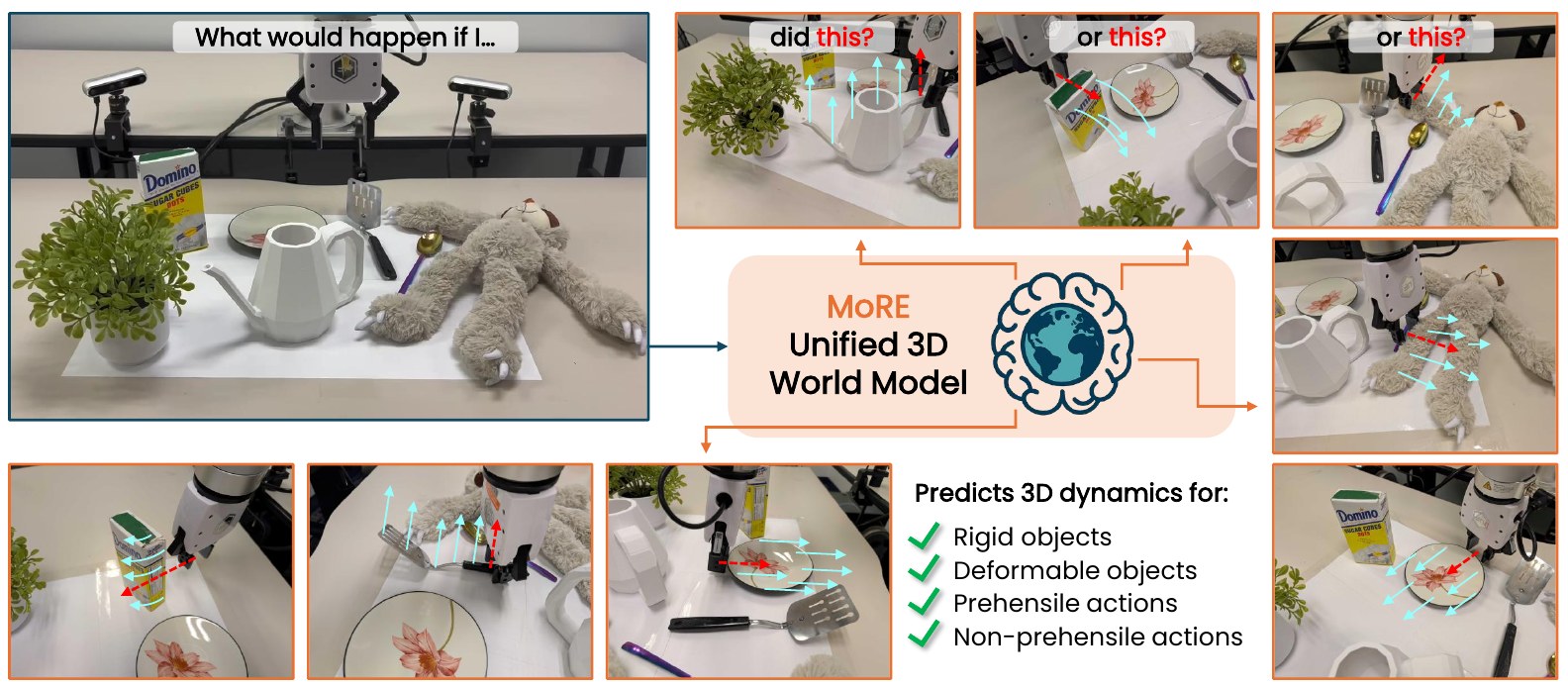
For manipulation, a world model should operate in 3D, handle multiple physical regimes and tools, and run feed-forward. Prior methods cover only some of these properties (see table). MoRE combines a large mixed simulation and real-world dataset with a physics-informed mixture of motion experts.
| Method | Feed- forward | Multi- physics | Multi- tool | 3D |
|---|
† ParticleFormer supports multiple tools but is trained per scene. PointWorld relies on implicit dynamics; MoRE explicitly routes to physics-aligned experts.
Method
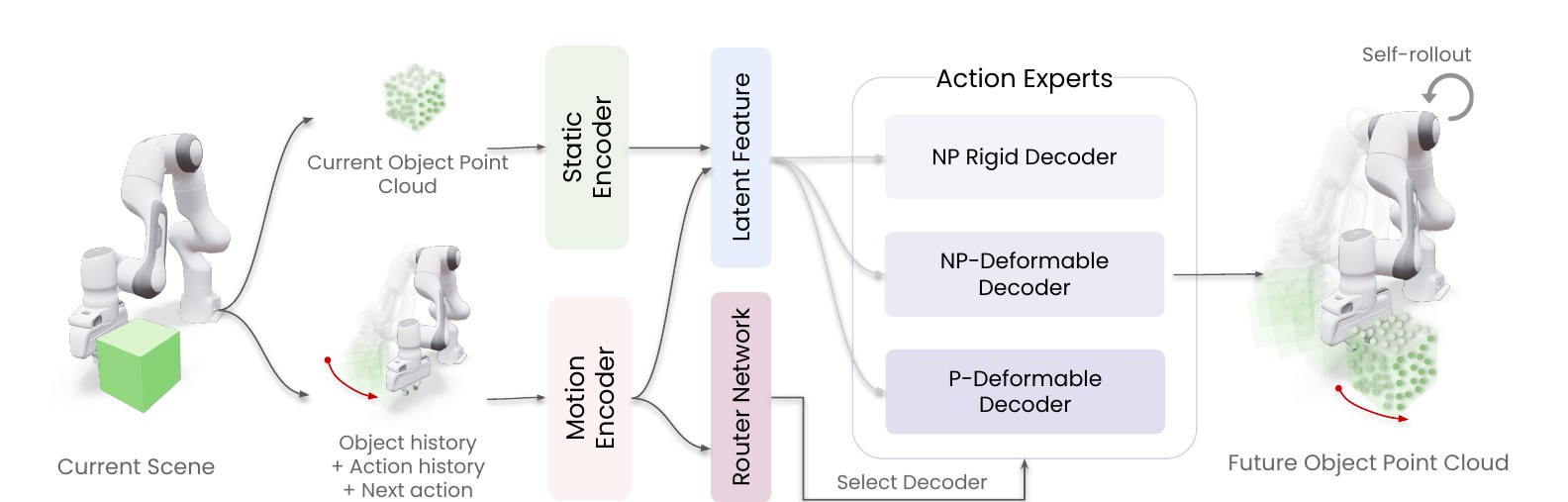
Expert routing
Planning with the world model
- Probe: a few random pokes; the router infers the regime.
- Sample: candidate pushes (M contacts × N directions).
- Roll out: every candidate with MoRE.
- Score: Chamfer distance to the goal; keep the best.
- Execute & re-plan: from the newly observed point cloud.
Results
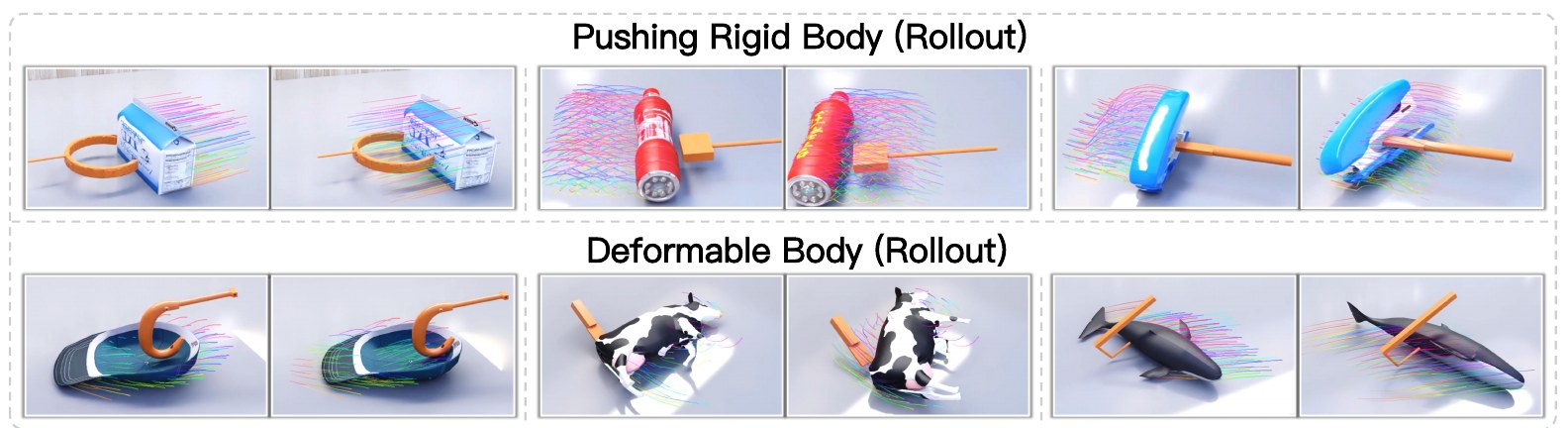
Drag the slider to step through the predicted 3D flow. MPC rollouts are shown as prediction → execution pairs, one planning step at a time.
Dynamics prediction in simulation
More simulation rollouts from the paper
Real-world prediction
Four interactions in the same scene: pushing a box, pushing a plate from two sides, and moving a plush sloth.
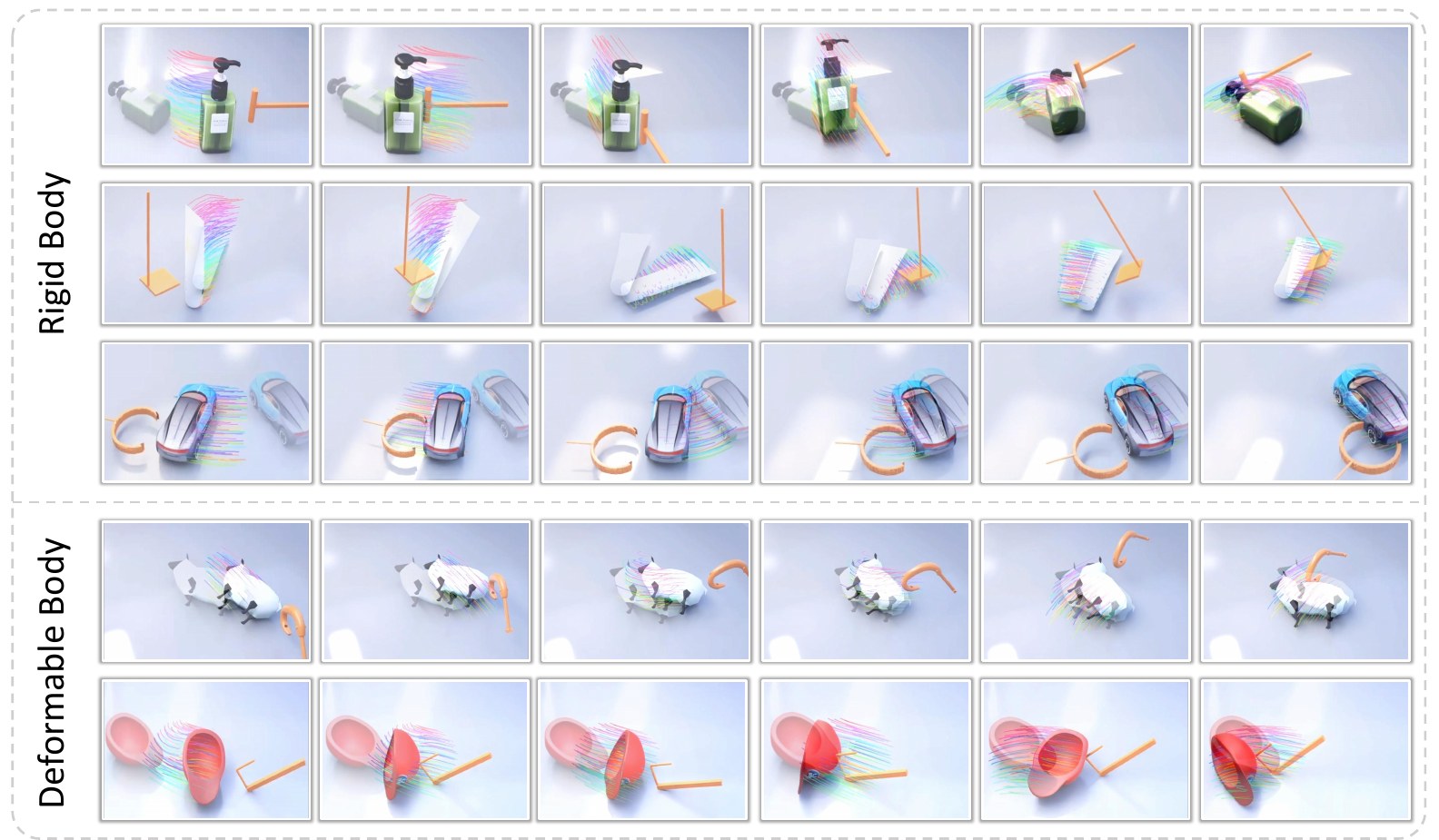
MPC rollouts in simulation
MPC rollout gallery from the paper
MPC in the real world
BibTeX
@inproceedings{zhu2026more,
  title     = {MoRE: Mixture-of-Experts for Multi-Physics Robotic World Models},
  author    = {Zhu, Ziyu and Liu, Shaowei and Zhai, Albert J. and Che, Henry and Ma, Wei-Chiu and Wang, Shenlong},
  booktitle = {Conference on Robot Learning (CoRL)},
  year      = {2026}
}
Acknowledgments. This project is supported by the NSF Awards #2331878, #2340254, #2312102, #2414227, #2404385, and #2525287. We greatly appreciate the NCSA for providing computing resources through Delta and Delta AI program. We thank the support from the NVIDIA Academic Grant Program for Researchers.